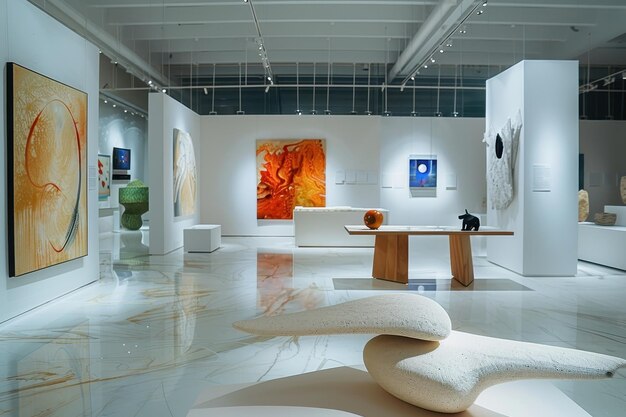
Major Adam Pendleton Exhibition Opens at the Museum, Exploring Blackness, Abstraction, and Language
A major exhibition examining the intersection of blackness, abstraction, and language has opened at the museum, bringing a significant contemporary art presence to the cultural landscape. The show represents a substantial commitment to showcasing work that engages with urgent questions about representation, form, and meaning in visual culture.
The exhibition positions abstraction not as a retreat from the world but as a direct engagement with it. Visitors will encounter works that challenge familiar assumptions about what abstract art can do and say—particularly in relation to questions of identity, history, and social practice. The curatorial approach suggests that visual language itself becomes a site where these conversations unfold.
How Abstraction and Politics Intersect
Abstract art often gets characterized as removed from social concerns. This exhibition works against that assumption by presenting abstraction as a tool for thinking through questions of representation and presence. The work on view demonstrates how formal choices—how color interacts with form, how scale shapes perception, how composition guides the eye—carry meaning that extends into the political and the personal.
Visitors familiar with contemporary art will recognize the stakes of this conversation. Abstract artists working today often find themselves negotiating between the modernist legacy of abstraction and contemporary demands for specificity and accountability. The exhibition doesn't resolve this tension so much as inhabit it, showing viewers what that negotiation looks like in practice.
Language as Form and Content
Much of the work engages with text and language directly. Words appear on canvas, in installation, across surfaces. Sometimes they read as clear statements; other times they dissolve into pattern and texture, becoming visual elements first. This approach treats language as material rather than mere vehicle—something to be shaped, obscured, repeated, and questioned.
The use of language connects to larger conversations about who gets to speak, whose language matters, and how meaning gets constructed and circulated. By treating words as visual forms, the work opens space for ambiguity and multiplicity. Viewers find themselves reading and looking simultaneously, neither activity sufficient on its own.
Themes of Visibility and Representation
The exhibition examines what it means to make work about blackness in predominantly white institutional spaces. Rather than offering comfort or easy resolution, the work asks difficult questions about representation, complicity, and the limits of visual culture to effect change. Some pieces directly address institutional critique; others work more obliquely, through formal strategies that implicate the viewer in acts of looking and interpretation.
This approach differs from representational strategies that aim to depict or celebrate black identity. Instead, the work explores how abstraction, language, and conceptual practice can engage with questions of race, visibility, and power in ways that resist simplification or recuperation.
What the Museum Offers
The museum itself functions as part of the conversation. Its architecture, its location, its history as an institution—all of these frame how visitors encounter the work. The exhibition takes advantage of this context rather than working against it, making the museum space itself a kind of text that viewers must read alongside the artworks.
For those new to contemporary abstraction, the exhibition provides an accessible entry point. The work doesn't require specialized knowledge, though viewers with experience in contemporary art will find additional layers to unpack. The formal strategies are clear enough to engage with directly, while remaining complex enough to sustain repeated looking.
The exhibition runs for an extended period, giving visitors multiple opportunities to return, to sit with particular works, to notice different things on subsequent visits. Abstract art often rewards this kind of sustained attention, revealing nuances that don't emerge in a single pass.
For anyone interested in how contemporary artists engage with fundamental questions about language, identity, and form, the exhibition represents a significant moment in local cultural life.